This is the first part I will be focusing on in the next few weeks. Seppuku is an interesting phenomenon that has held a great impact on Japanese culture and thinking, and will continue to do so for the foreseeable future. On a personal note, I will be picking up a few books on the topic from the library this week, as I feel like I can not do it complete justice with just online research.
 [2]
[2]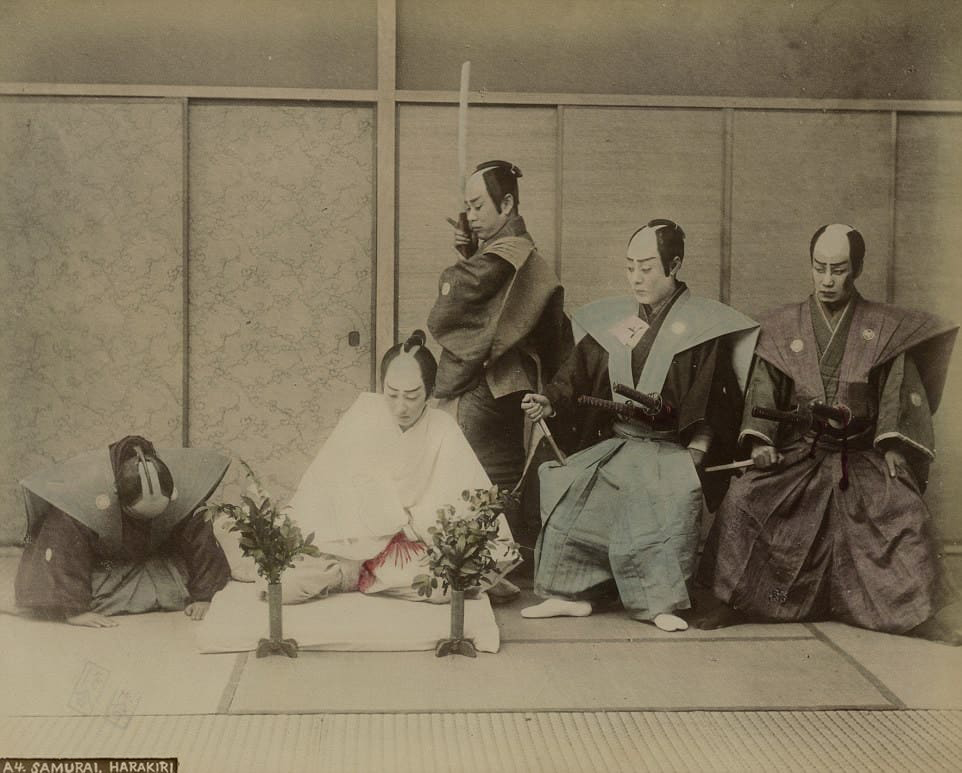
These are a few representations of Seppuku in Japanese culture, with the latter being staged
[4]
An artistic representation of ritual suicide from the movie "Budo- The Art of Killing"
Sources:
[1]"hara-kiri." The Columbia Encyclopedia. New York: Columbia University Press, 2013. Credo Reference. Web. 23 September 2013.
[2]https://upload.wikimedia.org/wikipedia/commons/b/bb/Seppuku-J._M._W._Silver.jpg
[3]https://upload.wikimedia.org/wikipedia/commons/5/5d/Seppuku.jpg
[4]https://www.youtube.com/watch?v=SVE7aqrva0g

![[3]](https://upload.wikimedia.org/wikipedia/commons/e/ec/Seppuku-2.jpg)
Adam,
ReplyDeleteI had read a number of descriptions of the gut cutting ritual through the years and of course was very moved as the pictures were etched permanently into what I laughingly call my memory..
Although I was way over-scheduled today, I had visiting your blog today on my list. The thirty minutes I had allotted for it seemed ample before the fact.
Thank you so much for your great work. I found myself coming on fire with your material and its many quality links. (The Seppuku Ceremony video led me to another and another...
There went my schedule.
Can't wait for the next one!
My blog is about human sacrifices. Though Seppuku is a ritual death, I'm not sure it would qualify as a sacrifice. Suicide can be a sacrifice. Or can it?
The Kamikaze pilot is certainly a war casualty. He is certainly a martyr. But is he a sacrifice?
Bob Hill