While I've been doing more research on Seppuku, I would like to take a bit of time to look at another form of suicide that was previously seen in Japan: the famous kamikaze. The word kamikaze means "Divine Wind" in Japanese, and comes from the story of an ancient typhoon in 1281 that destroyed a group of Mongrel invaders headed towards Japan. It was then later appropriated to talk about many young pilots from Japan who would drive their planes into Allied (mostly American) warships and other high profile targets to inflict massive damage and strike fear into the hearts of their enemies.[1]
A picture of the "Divine Wind" [2]
Pilots prepared for a kamikaze attack [3]
Its really fascinating to me whenever I think about this. Looking at it seems like a desperate last attempt by the Japanese to win an unwinnable war, but at the same time these people are bound by an ancient honor system that gives them courage. After checking out more books in the library, expect to see more this week.
[1]"kamikaze." Greenwood Encyclopedia of International Relations. Santa Barbara: ABC-CLIO, 2002. Credo Reference. Web. 30 September 2013. [2]http://en.wikipedia.org/wiki/File:MokoShurai.jpg [3]http://en.wikipedia.org/wiki/File:A6M5_52c_Kyushu.jpg
Sunday, September 22, 2013
Hari-Kari, also known as seppuku in its Chinese alternative, is the traditional art of honorable Japanese suicide (for the most part, both of the terms are interchangeable when referring to it in English). It was traditionally practiced by feudal warriors in Japan as a way of escaping falling into the enemies hands in the 1500's, which eventually evolved into a more elite way of execution when either the daimyo, Japanese feudal landholders and barons, and the samurai disobey the Emperor. During this time, the condemned man would receive a jeweled dagger, meant for disemboweling them, while their second chosen friend would behead them with their sword, putting them out of their misery. This tradition continued well into the 1900's, and was eventually outlawed in 1868, but it still persists even up to 1970[1].
This is the first part I will be focusing on in the next few weeks. Seppuku is an interesting phenomenon that has held a great impact on Japanese culture and thinking, and will continue to do so for the foreseeable future. On a personal note, I will be picking up a few books on the topic from the library this week, as I feel like I can not do it complete justice with just online research.
These are a few representations of Seppuku in Japanese culture, with the latter being staged
[4]
An artistic representation of ritual suicide from the movie "Budo- The Art of Killing"
Sources: [1]"hara-kiri." The Columbia Encyclopedia. New York: Columbia University Press, 2013. Credo Reference. Web. 23 September 2013. [2]https://upload.wikimedia.org/wikipedia/commons/b/bb/Seppuku-J._M._W._Silver.jpg [3]https://upload.wikimedia.org/wikipedia/commons/5/5d/Seppuku.jpg [4]https://www.youtube.com/watch?v=SVE7aqrva0g
Sunday, September 15, 2013
Adam Montgomery
The topic I would like to research would be suicide in Japan. Japan
has had a culture of suicide from
the ages of warriors, and retains
it today. Japan has the 9th largest amount of suicide, and
is the
number one cause of death for males aged 20-44. My question
is: why? Where did this culture come from, why is it still
perpetuated today, and why do so many people in Japan feel like it is
necessary to kill themselves. From Banzi Divers to school students,
Japan retains its unique situation of a suicidal populous.


 [2]
[2]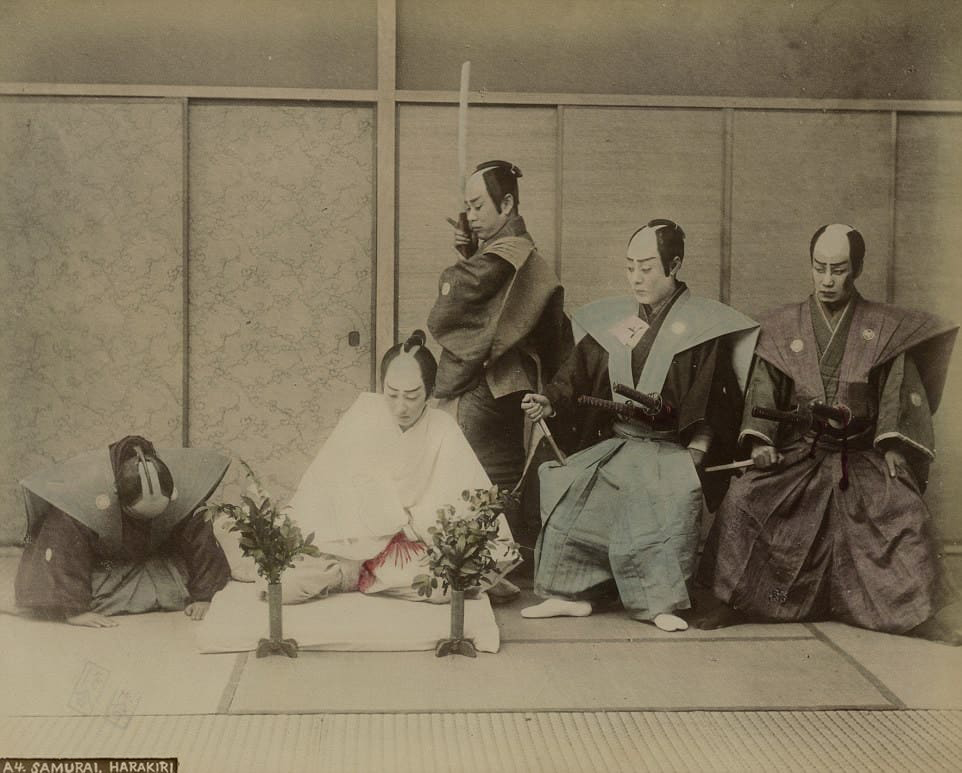

![[3]](https://upload.wikimedia.org/wikipedia/commons/e/ec/Seppuku-2.jpg)